Which award is for what?
3 min 3 secIncludes on-screen subtitles. Read the written lesson.
Painters and sculptors
Artists and architects from different periods include landscape painter John Constable, sculptor Henry Moore, and architect Christopher Wren. Wren designed St Paul’s Cathedral after the Great Fire of London. The Turner Prize recognises contemporary visual art.
Connect artists and architects with their work
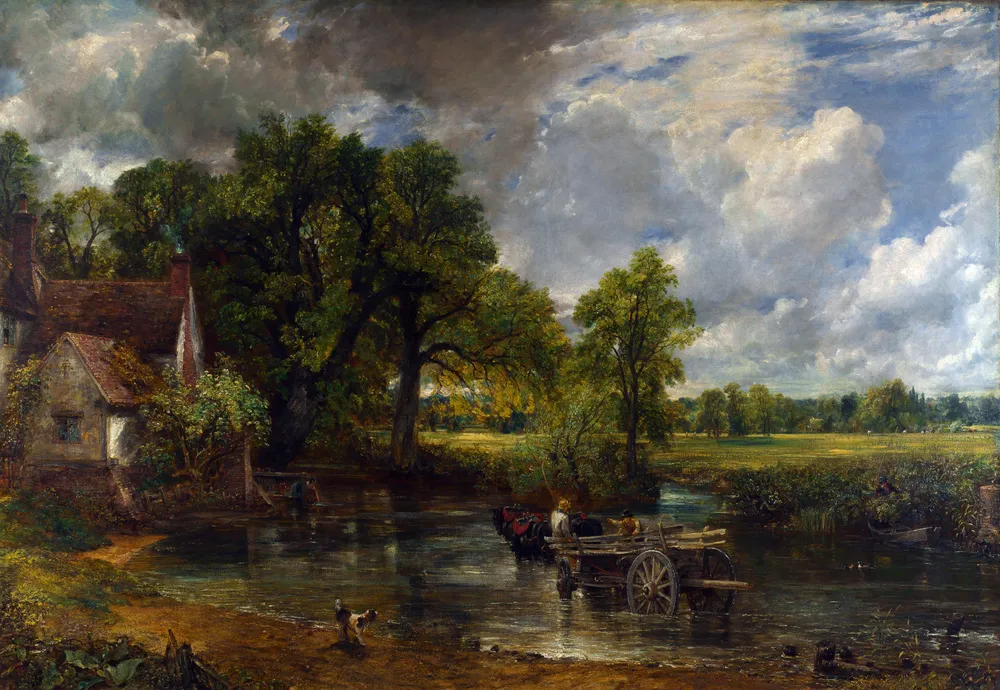
John Constable, The Hay Wain (1821) — landscape painting of the River Stour at Flatford. Link Constable with landscape painting; the “wain” is the wooden wagon in the water.
John Constable · National Gallery, NG1207 · public domain · Wikimedia Commons; resized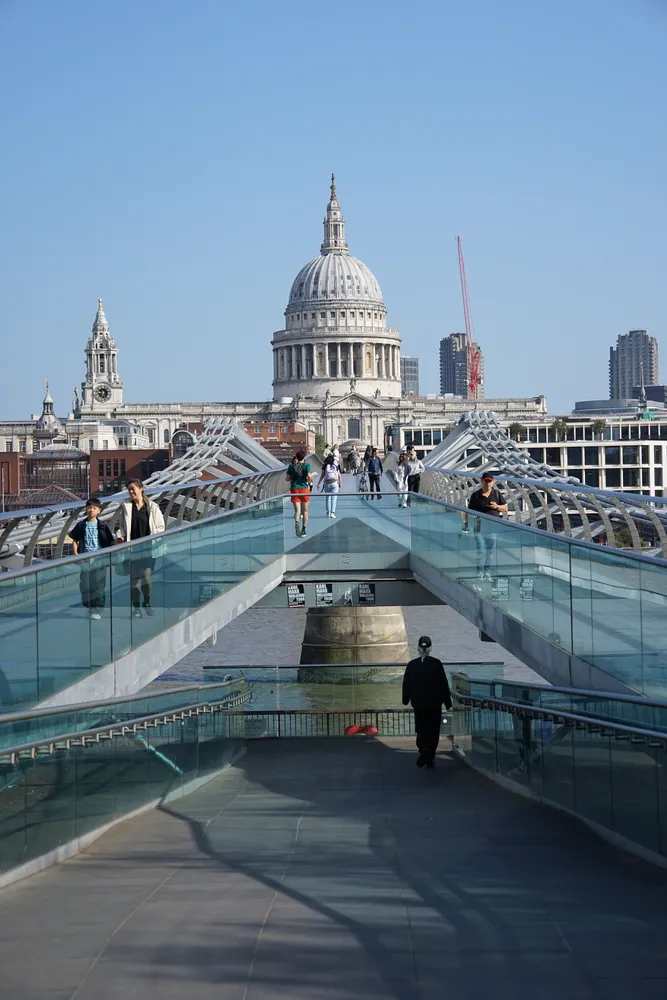
St Paul’s Cathedral, London — designed by Christopher Wren after the Great Fire of 1666. The Millennium Bridge is in the foreground.
ThunderFox24 · CC0 · Wikimedia Commons; resizedJ. M. W. Turner and John Constable are associated with landscape painting. Thomas Gainsborough is known for portraits and landscapes. David Hockney is a modern artist; Henry Moore and Barbara Hepworth are associated with sculpture.
Much medieval art in Britain was religious, including images in churches. The Reformation led to the destruction of many church images and changed patronage. Artists from overseas, such as Hans Holbein and Anthony van Dyck, later worked for the court. By the eighteenth century British portrait and landscape painting had developed distinctive traditions, including the work of Thomas Gainsborough.
Hans Holbein and Anthony van Dyck were overseas-born painters who worked in Britain in the sixteenth and seventeenth centuries. The nineteenth-century Pre-Raphaelites included Holman Hunt, Dante Gabriel Rossetti and John Everett Millais. They used bright colours and careful detail in pictures based on religion and literature.
David Allan was a Scottish painter whose works include The Origin of Painting. John Lavery was a Northern Irish portrait painter who painted members of the Royal Family. Welsh artist John Petts worked in engraving and stained glass. These associations link each artist with a distinct form of work.
Lucian Freud was a German-born British artist best known for portraits. David Hockney contributed to the pop-art movement of the 1960s. Henry Moore created large abstract bronze sculptures. Turner and Constable painted landscapes; Constable is especially associated with Dedham Vale on the Suffolk–Essex border.
The National Gallery, Tate Britain and Tate Modern are in London. National art collections are also found at the National Museum in Cardiff and the Scottish National Gallery in Edinburgh. The Turner Prize began in 1984 and recognises contemporary art; past winners include Damien Hirst and Richard Wright.
The Turner Prize exhibition is held at different UK venues, not permanently in one London gallery. Recent host cities have included Liverpool, Eastbourne and Bradford; the 2026 exhibition is at MIMA in Middlesbrough.
Painters oldest first
- Holbeinborn overseas, 1500s
- Gainsboroughportraits and landscapes
- Turnerlandscapes
- ConstableDedham Vale
- Lucian Freudportraits
- Hockneypop art
Architects and designers
Norman rulers built stone castles, including the White Tower at the Tower of London and Windsor Castle. Medieval Gothic architecture is seen in cathedrals such as Salisbury and Lincoln. Later architects revived the Gothic style: the Houses of Parliament and St Pancras Station are nineteenth-century examples, not surviving Norman buildings.
Inigo Jones designed the Queen’s House at Greenwich and the Banqueting House in Whitehall, drawing on classical architecture. Robert Adam designed buildings and their interior decoration, including work at Dumfries House. The Royal Crescent in Bath reflects eighteenth-century architectural taste. The nineteenth-century Gothic revival shaped the Houses of Parliament, St Pancras Station and major town halls.
Sir Christopher Wren designed St Paul’s Cathedral after the Great Fire of London. Robert Adam is associated with architecture and interior design. Charles Rennie Mackintosh worked in architecture and design in Scotland.
Sir Edwin Lutyens was an architect whose works include the Cenotaph in Whitehall, London. The Booker Prize is a major literary award for fiction; its current name does not include “Man”.
Lancelot “Capability” Brown designed country-house grounds to look natural, using grass, trees and lakes. Gertrude Jekyll designed colourful gardens and often worked with Edwin Lutyens. Lutyens also designed government buildings in New Delhi and war memorials including the Cenotaph. Modern British architecture includes work by Norman Foster, Richard Rogers and Zaha Hadid.
Thomas Chippendale designed furniture in the eighteenth century. Clarice Cliff designed Art Deco ceramics, and Terence Conran worked in interior design. Mary Quant, Alexander McQueen and Vivienne Westwood are important fashion designers. Design covers everyday objects and clothing as well as buildings.
Architects and garden designers oldest first
- Inigo JonesQueen’s House
- WrenSt Paul’s
- Capability Brownnatural-looking grounds
- Robert AdamDumfries House
- MackintoshScottish design
- LutyensCenotaph
Novelists
Jane Austen wrote Pride and Prejudice, Charles Dickens wrote Oliver Twist, and J.K. Rowling created Harry Potter. Westminster Abbey’s Poet’s Corner commemorates notable writers.
Jane Austen wrote Pride and Prejudice; Charles Dickens wrote Oliver Twist and A Christmas Carol; the Brontë sisters wrote novels including Jane Eyre by Charlotte and Wuthering Heights by Emily. Robert Burns is a Scottish poet celebrated on Burns Night, 25 January. Dylan Thomas was a Welsh poet; Seamus Heaney was a poet from Northern Ireland.
Charles Dickens’s characters have entered everyday speech. Scrooge stands for a mean person, while Mr Micawber is remembered for remaining hopeful that something will turn up. Jane Austen’s Pride and Prejudice and Sense and Sensibility explore marriage and family relationships.
Robert Louis Stevenson wrote Treasure Island, Kidnapped and Dr Jekyll and Mr Hyde. Thomas Hardy wrote about life in novels including Far from the Madding Crowd and Jude the Obscure. Ian Fleming created James Bond. Sir William Golding, Seamus Heaney and Harold Pinter received the Nobel Prize in Literature. Booker Prize winners have included Ian McEwan, Hilary Mantel and Julian Barnes.
Rudyard Kipling, author of The Jungle Book, became the first English-language Nobel literature laureate in 1907. Sir Arthur Conan Doyle created Sherlock Holmes; Agatha Christie wrote detective fiction. J. R. R. Tolkien wrote The Lord of the Rings, and J. K. Rowling created Harry Potter.
Agatha Christie wrote detective fiction and created Hercule Poirot and Miss Marple. These characters belong to her stories, not to Arthur Conan Doyle’s Sherlock Holmes series or Ian Fleming’s James Bond novels. Christie is often called the Queen of Crime because of her success in crime fiction.
Evelyn Waugh wrote satirical novels, including Decline and Fall and Scoop. Brideshead Revisited is among his best-known works. Satire uses humour and exaggeration to examine society and its faults.
Sir Kingsley Amis was an English novelist and poet who wrote more than twenty novels. Lucky Jim is his best-known novel. He is distinct from Evelyn Waugh, whose novels include Brideshead Revisited.
Graham Greene’s novels often explore moral questions and were influenced by his religious beliefs. His works include The Heart of the Matter, The Honorary Consul, Brighton Rock and Our Man in Havana.
Roald Dahl was born in Wales to Norwegian parents and served in the RAF during the Second World War. He wrote stories for adults as well as children. His children’s books include Charlie and the Chocolate Factory and George’s Marvellous Medicine, and several have been adapted for film.
J. K. Rowling wrote the Harry Potter children’s books, which became internationally successful. She has also written fiction for adults. The series is part of Britain’s popular literary culture, alongside Tolkien’s The Lord of the Rings and Dahl’s children’s stories.
The Booker Prize was first awarded in 1969 and is an annual award for eligible long-form fiction. Under its current rules the work must be written originally in English by an author of any nationality and published in the UK and/or Ireland. The older restriction to authors from the UK, Ireland or Commonwealth no longer applies. The International Booker Prize is a separate award for work translated into English.
Novelists oldest first
- AustenPride and Prejudice
- DickensOliver Twist
- BrontëJane Eyre
- Hardyrural life
- StevensonTreasure Island
- Conan DoyleSherlock Holmes
- KiplingThe Jungle Book
- ChristiePoirot
- TolkienThe Lord of the Rings
- WaughBrideshead Revisited
- Greenemoral questions
- Dahlchildren’s stories
- AmisLucky Jim
- RowlingHarry Potter
Poets and Nobel Prize winners
Beowulf is an Anglo-Saxon poem about a hero fighting monsters. Sir Gawain and the Green Knight is a medieval poem about a knight of King Arthur’s court. John Milton’s Paradise Lost reflects religious ideas of the seventeenth century. Shakespeare also wrote sonnets: poems of fourteen lines.
William Wordsworth wrote the poem commonly called Daffodils or The Daffodils, also known by its opening words, I Wandered Lonely as a Cloud. Wordsworth was one of the Romantic poets and is closely associated with the Lake District.
William Blake wrote The Tyger, beginning “Tyger! Tyger! Burning bright”. Lord Byron wrote She Walks in Beauty. Robert Browning wrote Home Thoughts from Abroad, which opens with a wish to be in England in April. Wilfred Owen’s Anthem for Doomed Youth reflects the deaths of soldiers in the First World War. Owen and Siegfried Sassoon both drew on wartime experience. Wordsworth’s Daffodils evokes a field of flowers seen by a wandering speaker.
Robert Burns, known in Scotland as the Bard, wrote in Scots and English and adapted traditional songs. His Auld Lang Syne is sung at New Year. Walter Scott wrote poems and novels inspired by Scotland, its history and Border traditions. Agatha Christie wrote detective stories, Arthur Conan Doyle created Sherlock Holmes, and Tolkien wrote The Lord of the Rings.
Nineteenth-century poetry includes work by John Keats, Percy Shelley, Alfred Lord Tennyson, Robert Browning and Elizabeth Barrett Browning. Later poets include Walter de la Mare, John Masefield, John Betjeman and Ted Hughes. Poet’s Corner in Westminster Abbey commemorates writers from different periods. Learn poets alongside their writing and themes: nature for Wordsworth, Scottish traditions for Scott and the First World War for Owen and Sassoon.
Dylan Thomas was a Welsh poet and writer born in Swansea. He wrote the radio play Under Milk Wood and the poem Do Not Go Gentle into That Good Night. He performed his writing in public and for BBC broadcasts. His work is an important Welsh contribution to English-language literature, and the Dylan Thomas Centre in Swansea commemorates him.
Writers associated with Britain and Ireland who received the Nobel Prize in Literature include Rudyard Kipling, T. S. Eliot, William Golding, Seamus Heaney and Harold Pinter. Eliot was born in the United States and became a British citizen. Nobel recognition is different from the Booker Prize, which is awarded for an eligible work of fiction under its own rules.
Poets oldest first
- BlakeThe Tyger
- BurnsAuld Lang Syne
- WordsworthDaffodils
- ByronShe Walks in Beauty
- BrowningHome Thoughts from Abroad
- Dylan ThomasUnder Milk Wood
- HeaneyNobel Prize